2016年7月13日星期三

Low-power cost-effective PIC32 MCUs

Microchip® Technology Inc. introduced its lowest power and most cost-effective family of 32-bit PIC32 microcontrollers (MCUs). The Microchip PIC32MM family bridges the gap between the company’s popular PIC24F XLP and PIC32MX families. The new family is the first PIC32 to feature core independent peripherals, designed to offload the CPU for lower power and lower system design. The PIC32MM devices are supported by the Microchip MPLAB® Code Configurator (MCC) to help simplify and accelerate designs.

Today’s embedded applications targeting the Internet of Things (IoT), consumer, industrial control, and motor control require flexible MCUs that consume less power, are more cost effective and have smaller form factors. For applications demanding low power and longer battery life, the PIC32MM has sleep modes down to 500 nA. Applications with space constraints will benefit from the small 4 × 4 mm package options. The PIC32MM devices include core independent peripherals such as Configurable Logic Cells (CLC) and Multiple-output Capture Compare PWMs (MCCPs) which help enable sensorless BLDC motor control applications.

“With volume pricing starting at $0.60, sleep modes down to 500 nA, and compact 4 × 4 mm packages, the PIC32MM family offers a compelling solution for applications with budget, power and size constraints,” said Joe Thomsen, vice president of Microchip’s MCU16 business unit. “Supported by the popular MPLAB Code Configurator tool, these PIC32MM devices are easy to set up, accelerating design schedules for rapidly changing markets.”

If you want to know more about PIC32MM , you can come to our website "http://www.kynix.com/Search/PIC32.html"

2016年7月12日星期二

LM5080 -- Modular Current Sharing Controller

The LM5080 is a simple and cost effective load share controller that provides all functions required to balance the currents delivered from multiple power converters operated in parallel. The LM5080 implements an average program (AP) method of active load share control which adjusts the output voltage of individual power stages either up or down to deliver nearly equal currents to a common load. The average program method improves stability and reduces the output voltage tolerance when compared to other common load sharing methods. The LM5080 supports two common applications for load sharing methods. The LM5080 supports two common applications for load share controllers: external control in which the load share circuit balances currents between separate power modules (bricks), and internal control where the load share circuit is integrated into the voltage regulation loop of each power converter module or circuit.

Features
1.       Average program current share method
2.       Single-wire star link current share bus
3.       No precision external resistors necessary 3V to 15V bias voltage range
4.       Adaptable for high or low side current sensing
5.       Flexible architecture sense adjustment
6.       Positive remote sense adjustment
7.       Trim or reference adjustment

Our company produces this product,if you want to know more, come to our website. www.kynix.com

2016年7月11日星期一

Kynix --- A rising star in electronic components

With the development of modern society, everything has created its own developing process and rules. There is no exception for the electronic components. It has undergone typical electronic components, mini electronic components, ordinary electronic components and smart mini electronic components. The electronic industry is going to the gorgeous future.
 There are many types of micro electronic components including integrated circuits, mixed integrated circuits, chip and flat electronic or electronic mechanical component and so on.
Passive Components Manufacturers play a key role in the development of the electronics industry and more globally in the development of the e-society in Europe and the rest of the world. Every new function, every new semiconductor, generates new requirements in volume and performance for passive components. Supported by several large companies and a great number of SMEs (small and medium sized enterprises), the passive component industry has accumulated a considerable competence and know-how over the years. For example it has been capable of producing the sophisticated parts required for the European world-leading mobile phone and automotive industries. Electronic systems and equipment, as well as electronic components, are undergoing crucial changes. Increasing performance and miniaturization are becoming standard requirements, as are decreasing prices. European industry has been able to face up to these challenges successfully.
With millions of electronic parts available from around the world, finding the right part, in stock, and for the right price can be difficult. Luckily there are several worldwide electronic parts distributors that provide services for hobbyists to OEMs. Many of the global electronics distributors also provide a number of tools to manage projects as well as design services to help build that next product. One of the companies Kynix is building to become a better server for us.

  Kynix from HongKong Limited company was founded in 2008, specializing in electronic components distribution business.  With the accurate quotation, excellent credit, reasonable price, reliable quality, fast delivery, authentic service, they have won the praise of majority of customers.
Kynix's customer groups include:  aerospace service providers; medical devices manufacturers; research institutions, telecommunications equipment manufacturers; automotive electronics manufacturers; nuclear power, industrial equipment manufacturers; in addition to serving for many large, medium and small electronic components agents and distributors. Kynix has gradually built up a number of channels of supply and cooperation relationships, providing customers with excellent products, chain management services and full technical support to meet our customers' product development and production.

  Although Kynix is not so famous like Mouser Electronics, Digikey Electronics, we are trying to be better and you will be the honorable customers for us. Kynix will promise we won’t let you down. 

2016年7月9日星期六

How to recognize the structure of the electronic conponents

All electronic equipment is made up of many component parts and all of them  work together, modifying and managing current and voltage in all kinds of different ways. Most components are independent, off-the-shelf parts; they have distinctly identifiable shapes, sizes and colors. After these simple introductions you can learn to identify what the different parts are and I will enclosed some pictures for better understanding the structure.

Circuit Board

The circuit board itself is a thin plastic rectangle, usually mounted inside the equipment case. Small boards are matchbook-sized; large ones can measure 20 inches or more on a side. A typical board has components on one side and conductive copper foil paths on the other that serve as the circuit’s wiring. Boards are usually tan or blue, but also come in other colors.


Schematic Diagram

·      A schematic diagram for an electronic circuit can be a helpful guide to identifying components. In the schematic, straight solid lines indicate wiring and connections between various parts. Short zigzag lines are resistors. Capacitors are represented by short parallel lines that may be straight or curved. Transistors and diodes have arrows indicating the direction of current flow. Complex components such as integrated circuits are represented by a block diagram. Each symbol is typically labeled with a letter and a number according to a standard scheme.


Integrated Circuits

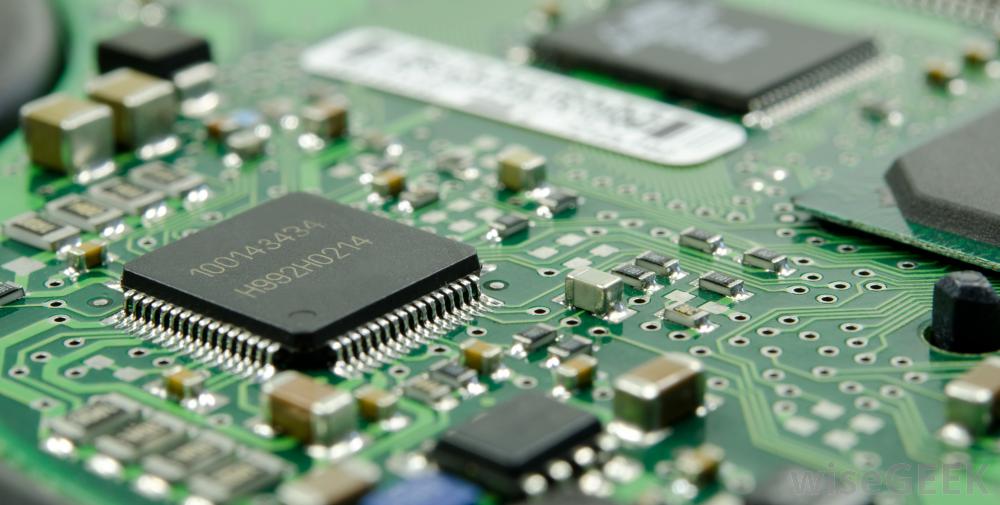
·     Integrated circuits are miniature electronic components that may contain up to billions of microscopic transistors, resistors and other parts. Although they come in many different package styles, they generally are dark rectangular slabs of plastic or ceramic that connect to the board via several metal pins; they have a passing resemblance to small pieces of dark chocolate. ICs usually have part numbers written on them to help you identify them.


Resistors

·      Resistors are simple electronic components that limit the amount of current passing through a circuit. On a board, resistors are small horizontal cylinders bearing four or five colored stripes; the stripes are a code that reveals the part’s resistance in ohms. For example, the color code red-red-orange-gold is a 22,000-ohm resistor accurate to 5 percent. A board may have dozens of resistors.


Capacitors

·         Resistor is electronic device between the two terminals. When the electric current passes by, the voltage and the electronic is the direct proportion. Capacitors serve as storage containers for electric charge, and are rated by capacitance in farads and breakdown voltage in volts. Although vintage capacitors have color codes, modern examples typically have the farad and breakdown voltage ratings printed on the part. Capacitors may be vertical or horizontal cylinders, disk-shaped or resemble glossy gumdrops.


Connectors

·      A circuit board may have one or more connectors attached to it; a cable snaps onto the connector and carries electrical signals from it to other parts of the electronic equipment. Connectors are usually plastic and have one or more metal pins or fittings that mate with the cable.


To know more, you can see the video from youtube
https://www.youtube.com/watch?v=VN8BA3eElJo
If you have the requirement for the electronic components, please come to http://www.kynix.com.
Here is the contact number
+86-755-8860-5655

2016年7月6日星期三

Low Capacitance ESD Protection Diodes Micro−package Diodes for ESD Protection

The ESD7181 is designed to protect voltage sensitive components that require ultra−low capacitance from ESD and transient voltage events. Excellent clamping capability, low capacitance, low leakage, and fast response time make these parts ideal for ESD protection on designs where board space is at a premium. It has industry leading capacitance linearity over voltage making it ideal for RF applications.
 Features
• Low Capacitance 0.3 pF (Typical)
• Low Clamping Voltage
• Small Body Outline Dimensions: (0.62 x 0.32 mm) − 0201
• Low Body Height: 0.3 mm
• Working Voltage: ±18.5 V
• Low Leakage < 1 nA (Typical)
• Low Insertion Loss
• Low Dynamic Resistance: < 1 W
• IEC61000−4−2 Level 4 ESD Protection
• SZ Prefix for Automotive and Other Applications Requiring UniqueSite and Control Change Requirements; AEC−Q101 Qualified andPPAP Capable
• These Devices are Pb−Free, Halogen Free/BFR Free and are RoHSCompliantTypical Applications
• RF Signal ESD Protection
• Wireless Charger
• RF Switching, PA, and Antenna ESD Protection
• Near Field Communications
ESD Voltage Clamping
For sensitive circuit elements it is important to limit the voltage that an IC will be exposed to during an ESD event to as low a voltage as possible. The ESD clamping voltage is the voltage drop across the ESD protection diode during an ESD event per the IEC61000−4−2 waveform. Since theIEC61000−4−2 was written as a pass/fail spec for larger systems such as cell phones or laptop computers it is not clearly defined in the spec how to specify a clamping voltage at the device level. ON Semiconductor has developed a way to examine the entire voltage waveform across the ESD protection diode over the time domain of an ESD pulse in the form of an oscilloscope screenshot, which can be found on the datasheets for all ESD protection diodes. For more information on how ON Semiconductor creates these screenshots and how to interpret them please refer toAND8307/D.

Learn more about:online ordering 

2016年7月5日星期二

Everyday a product :LM2940-5.0与7805的比较

   LM2940 has high conversion efficiency than the 7805. There will be 3mA current consumption (quiescent current)when 7805 without direct input connected to the output of the internal situation. LDO element quiescent current is far smaller than it.The LM2940 is a LDO (LDO means a low dropout regulator, which means higher low dropout linear regulator, as opposed to the traditional linear regulator. The traditional linear regulators, such as the 78xx series chips' input voltage are required to higher than the output voltage 2v ~ 3V at least, or it will not work properly. However, in some cases, this condition is clearly too harsh, such as 5v turn  3.3v, differential input and output is only 1.7v, apparently not satisfied with the conditions. The LDO class power conversion chip were invented only for this case.
LM2940-5.0 low dropout three-terminal regulator chip
Model: LM2940-5.0P + Package: TO-220
   Fixed output voltage low dropout three-terminal regulator; the output voltage of 5V; Output Current 1A; the output current is 1A, the minimum input-output voltage is less than 0.8V; maximum input voltage of 26V; Operating Temperature -40 ~ + 125 ; intron quiescent current reduction circuit, current limiting, thermal protection, and reverse battery protection circuit-insertion.
   The UTC LM2940 is a low dropout regulator designed to provide output current up to 1A with a typically 500mV dropout Voltage and a maximum of 1V. It is capable of reducing the ground current when the differential between the input voltage and the output voltage. 


  Want to buy electronic components with lower prices but have a really good quality ? Click this !


2016年7月4日星期一

Connecting leaders in Internet of Things

Global Semiconductor and Electronics Forum 2017


Connecting leaders in Internet of Things – this is still very much the hot topic in consumer electronics and automotives. 
We had Samsung Electronics open the forum for us with a frank admission that profitability has yet to be seen from IoT, but it is early days in adoption. 
Dell shared the important role data scientists played and it is efficiency, safety and customer satisfaction that are the crucial factors driving IoT. This is essential for businesses to bring IT and operational technology to make it work. They also outlined the exponential growth of IoT and data will lead to the network infrastructure unable to cope with the current progress in the cloud even with the declining cost of data analytics, but you can sell data to other companies to profit. Ultimately it is cloud security that is the biggest concern for businesses.
We also heard from start-up wearables company, Misfit sharing the wearables 2.0 evolution beyond being the current health tracker with their goal to create elegant, customisable products and they’ve survived by doing more with less and procuring brand partnerships that have allowed them global recognition.
Whirlpool outlined their vision for the connected home and the move towards super intelligence, they see emotional interaction – human elements are added to technology.
On the automotives side, we had Qoros Auto explain the level of connectivity already offered in their cars where every 15 seconds data is uploaded to their cloud and telematics relies upon constant user engagement to provide them with different services. 60% of the value from the bought car comes from services. To Qoros, innovation needs speed, but you need to think about the design and architecture from day 1. They’re building a Qoros car community based on social, ecommerce, loyalty and fun, tapping into the 570 million active users on WeChat who can share their location for geo-targeted marketing.
However, how can you benchmark connectivity in the car? There are no industry benchmarks. So is it lifetime of services or profitability of services that companies need to focus on?
PSA Peugeot Citroën was telling us China is launching a user based insurance in 2017 in 6 cities as a pilot which will further propel the car sharing market. The car will just become another device in the IoT world for data collection. They expect cars to be fully automated by 2020 and be self-driving by 2025. The transition would see the car as a service rather than ownership. This is in line with the rise of the shared economy for pay-per-use services. Maps and navigation is a strategic resource for the autonomous car market. Tesla, the leader in connected cars, built the battery and infotainment first and is the inspiration for the industry especially as a start-up. SAIC-Alibaba have followed a similar route with AliOS in the cars, keeping customers in their ecosystem to push content.
OEMs are shifting to be more mobile, for example PSA is used for car sharing in Berlin and France and will launch in China in 2-3 years. The mindset is changing as the industry is disrupted by the internet players. They’re investing in developers, but this needs to be done cost effectively as apps are updated daily, devices change every 6 months but cars are built to last.
IoT can be seen as a risk to the automotive industry if you don’t reinvent yourselves. OEMs can only survive by using data effectively and not be just a hardware supplier.
You need to be agile, investing in start-ups because if you don’t disrupt yourself today, you’re going to be disrupted tomorrow. These disruptions are coming so OEMs are creating brands to manage that so that the value is transferred from the hardware to software.
Data ownership is still the big question but this is dependent on the contract and the location so in China for example all data is monitored by the Government. Who pays for the data? This depends on the apps that the automotive companies benefits from.
Industry standards are the biggest challenge as consumers don’t want to buy and understand all the different standards – they just want everything integrated.
BMW debated the responsibility model when it came to autonomous cars; they’re working with Baidu in China to test the autonomous car in Shanghai and advises partnerships with local Chinese internet companies to navigate the different ecosystem and legal system.
To end the day, we had GE look at what IoT meant on an industrial scale from digital wind farms to software defined machines, but ultimately industrial data storage is required.
As IoT develops, questions over standards and security will need to be answered and for 2017 this will be top of the agenda, but are there any other critical issues you want covered?